UPPER EYELID SURGERY
Upper eyelid surgery, or upper blepharoplasty, addresses excess skin and, sometimes, fat that make the eyes look heavy, tired, or hooded. For some people this is purely about appearance; for others, sagging upper lid skin has started to sit on the eyelashes or drift into the field of vision. Either reason is valid, and the right technique depends on which one applies to you.
• Opens up the eyes and softens a heavy, hooded, or tired appearance
• Can restore the upper field of vision if excess skin has started to droop over the lashes
• Creates or refines an eyelid crease, which some people are not born with
• Results sit under a natural brow and lash line, so the change usually reads as 'well-rested' rather than 'done'
• Excess or crepey skin on the upper eyelid, with or without a visible fold
• A faint, uneven, or absent eyelid crease you would like defined
• Mild fullness from fat pockets under the brow bone
• Good general eye health, with no uncontrolled dry eye or thyroid eye disease
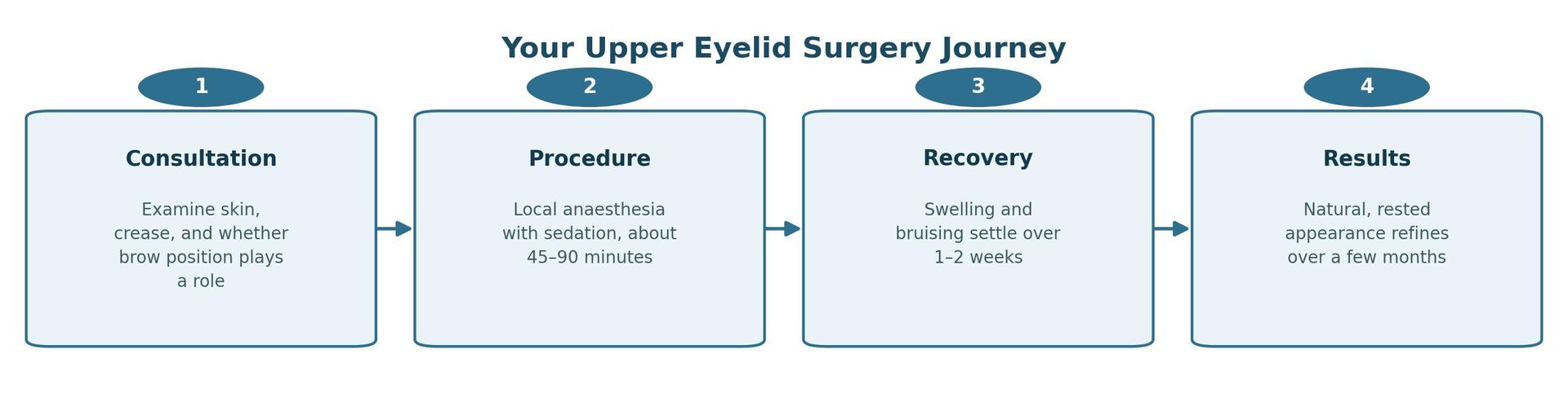
It is worth being honest with yourself about what is driving the heaviness — sometimes it is the eyelid skin itself, and sometimes the brow has dropped and is pushing the lid down. Your surgeon should examine both before recommending a technique.
TREATMENT
There are a few different ways to approach the upper eyelid, and the choice depends on your anatomy, how much skin needs addressing, and whether a crease already exists.
• Suture (non-incisional) technique: fine sutures are placed to create or reinforce a crease without removing skin, mainly for people with good skin quality who mainly want a defined fold rather than skin removed — quicker recovery, though the crease may soften over time
• Incisional technique: a fine incision is placed along the natural or planned crease line, through which excess skin, muscle, or fat is removed and the crease is re-formed — more definitive and longer-lasting, at the cost of a healing incision
• Sub-brow excision: skin is removed as a crescent just under the eyebrow instead of at the lid crease, suited to heavier lateral hooding, thicker skin, or where preserving the existing lid crease matters — the resulting scar sits hidden along the lower brow border rather than in the lid fold
• Surgery is usually done under local anaesthesia with light sedation, and takes around 45 minutes to 1.5 hours
• Most swelling and bruising settle within 1 to 2 weeks
• Stitches, if used, are typically removed within a week
• Light activities can usually resume within a few days; exercise is held off for around 2 weeks
• Scars continue to fade and soften over several months, usually settling into the natural crease or brow line
FAQs
Upper eyelid surgery is generally well-tolerated, but as with any surgery around the eye, it is worth understanding both the common, minor effects and the rarer, more serious ones.
• Temporary bruising, swelling, and dry or irritated eyes
• Mild asymmetry between the two sides, which may need minor touch-up
• Under- or over-removal of skin, affecting eyelid closure or the final look
• Visible or thickened scarring, though this is uncommon in the eyelid crease
• Temporary difficulty fully closing the eyes (usually settles as swelling resolves)
• Ver rarely, bleeding behind the eye (retrobulbar haemorrhage) is a medical emergency requiring urgent attention
COMPLICATIONS AND MANAGEMENT
How do I know if I need the suture technique or the incisional technique?
It largely comes down to your skin quality and goals. If you mainly want a defined crease and have minimal excess skin, the suture technique may be enough. If there is more skin or fat to remove, the incisional approach gives a more thorough and lasting result. Your surgeon can advise after examining your eyelids.
What is sub-brow excision, and why would I need it instead of a normal eyelid crease incision?
It is a way of removing excess skin through an incision just under the eyebrow rather than in the eyelid crease itself. It is often considered when the brow area, not just the lid, is contributing to heaviness, or when a person prefers to keep their existing lid crease unchanged. The trade-off is a scar along the lower brow instead of within the lid fold.
Will people be able to tell I've had it done?
The aim is a natural, rested look rather than an obviously altered one. Swelling in the first couple of weeks can look more noticeable than the final result, so it helps to plan the timing around this if you'd rather keep things private.
Does upper eyelid surgery help with vision?
It can, if drooping skin has genuinely started to overhang the lashes and encroach on your upper field of vision. This is sometimes assessed with a formal visual field test, which can also support insurance or medical claims where relevant.
How long do the results last?
Skin and fat removed do not come back, so results are generally long-lasting. That said, your eyelids continue to age afterwards, so skin laxity can gradually return over many years.
Can this be combined with other procedures?
Yes, it is commonly combined with lower eyelid surgery, brow lift, or non-surgical treatments. Whether that makes sense for you depends on what is actually contributing to how tired or heavy your eyes look.