
ABDOMINAL WALL RECONSTRUCTION
Author: Dr Chia Hui Ling
Abdominal wall reconstruction repairs significant defects in the muscle, fascia and skin that form the abdominal wall, going beyond a routine hernia repair. It is generally reserved for larger or more complex defects, such as recurrent hernias, gaps left after tumour removal, or tissue loss following severe infection, where a simple stitch or standard mesh repair is unlikely to hold.
• Restores the structural integrity of the abdominal wall so it can support the organs and withstand everyday strain, such as coughing or lifting
• Achieves durable wound closure where previous repairs have failed or broken down
• Reduces, though cannot eliminate, the risk of the defect recurring
• Can improve comfort, posture and the ability to return to normal activity
• People with large or recurrent incisional hernias at the site of a previous surgical scar
• Those with a defect left after removal of a tumour involving the abdominal wall
• Patients who have lost abdominal wall tissue to severe infection, such as necrotizing fasciitis
• Anyone referred by a general or colorectal surgeon because a defect is too large or complex for standard repair
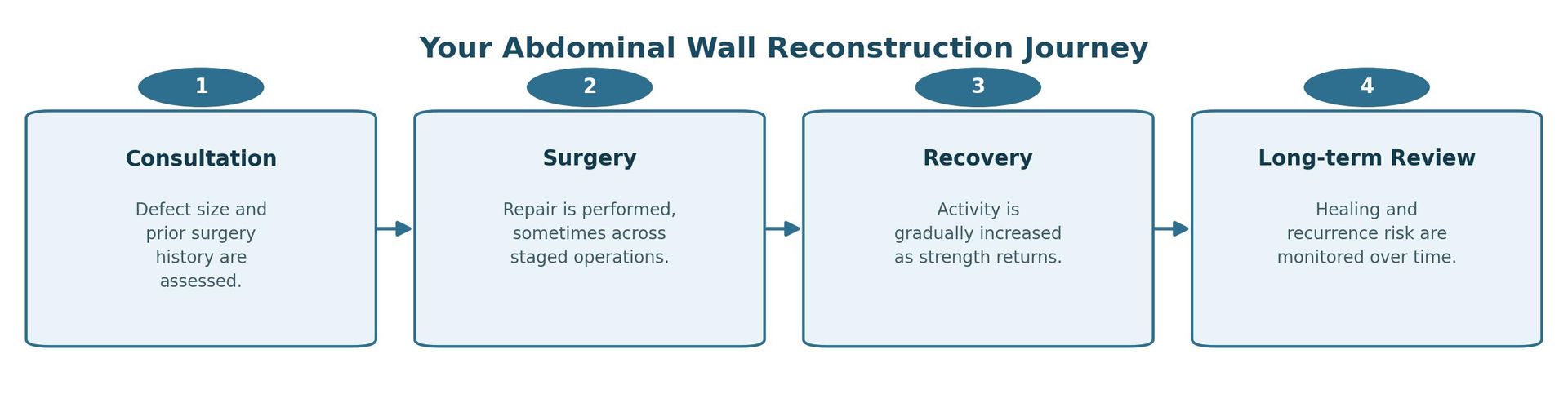
This is major reconstructive surgery, often planned jointly with the surgeon managing the underlying condition, and it may take more than one operation to complete safely.
TREATMENT
The technique chosen depends on the size and location of the defect, whether infection is present, and how much native tissue remains.
- Component separation: releases and repositions the abdominal wall muscle layers toward the midline, allowing closure of defects too wide to bridge directly
- Mesh reinforcement: synthetic or biologic mesh adds strength and reduces recurrence risk; the type used depends partly on whether the wound is contaminated
- Flap reconstruction: brings in tissue with its own blood supply, such as from the thigh, when local tissue or skin is insufficient
- Staged closure with negative pressure wound therapy: for severe infection, the abdomen may be left open temporarily under a vacuum dressing until the wound is clean enough for definitive closure
- Recovery varies considerably with complexity: straightforward repairs often involve about a week in hospital, while staged or flap-based reconstructions take longer. Heavy lifting and straining are usually restricted for weeks to months afterward to give the repair time to gain strength, on a timeline your surgical team will individualise.
FAQs
Is mesh always used, and is it safe?
Mesh is used in many, though not all, abdominal wall reconstructions because it adds strength and lowers the chance of the repair failing. There are synthetic and biologic options, and the choice depends on factors such as whether infection is present; your surgeon will explain the reasoning for your specific case.
Will the hernia or defect come back after surgery?
There is always some chance of recurrence, even after a well-performed repair, and this risk rises with obesity, smoking, or conditions that raise abdominal pressure such as chronic coughing. Steps like smoking cessation or weight management before surgery can help where relevant.
How long will I be in hospital and off work?
This depends heavily on complexity. Simpler repairs may mean about a week in hospital and a return to normal activity within several weeks, while complex staged reconstructions involve a longer stay and a more gradual return over a few months.
What is component separation?
It is a technique that releases certain abdominal wall muscle layers so they can move closer to the midline, closing a large defect using your own tissue, often combined with mesh. It is one of several options chosen based on the defect's size and nature.
Why might my abdomen be left open temporarily after surgery?
In severe infection or significant swelling of the abdominal contents, immediate closure can be unsafe. The wound may instead be managed with a temporary, sometimes vacuum, dressing over one or more procedures until it is stable enough for definitive closure.
Will I need to change my activity permanently after reconstruction?
Most people return to their usual activities, including exercise, once the repair has healed and gained strength, though heavy lifting is usually restricted for a period afterward. Long-term guidance depends on the size of the repair and your individual risk factors.
COMPLICATIONS AND MANAGEMENT
Risks relate both to the underlying condition and to the reconstructive technique used.
• Recurrence of the hernia or defect over time, more likely with obesity, smoking, or chronic cough
• Infection of the wound or, less commonly, the mesh itself, occasionally requiring further surgery
• Wound breakdown or delayed healing, particularly over a large repair
• Fluid or blood collection beneath the skin (seroma or haematoma), sometimes needing drainage
• In very large repairs, a rare risk of raised abdominal pressure (abdominal compartment syndrome) if closed under excessive tension
• General surgical and anaesthetic risks, including bleeding and clot formation, as with any major abdominal surgery
Your team will talk through which of these are most relevant to you, including any factors that raise your individual risk of recurrence or wound problems.