ASIAN BLEPHAROPLASTY
Asian blepharoplasty, often called double eyelid surgery, creates or refines an upper eyelid crease for people who have a single eyelid (monolid) or an uneven, low, or partial crease. The aim is a crease that suits your own eyelid anatomy and facial proportions, not a fixed template.
• Creates a natural, permanent eyelid crease where there was none, or refines an uneven one
• Makes the eyes appear more open and the gaze more alert
• Allows eyeliner and eye makeup to sit and show more easily
• Can address mild hooding or excess skin at the same time
• Crease height and shape can be customised to the individual eyelid
• No natural crease, or a crease that is uneven, faint, or partial
• Mild excess skin or fat over the eyelid affecting the fold
• A preference for a permanent result over daily tape or glue methods
• An understanding that this reshapes the eyelid, not the size of the eye itself
• Realistic expectations about a crease that complements, rather than changes, the natural Asian eyelid
The crease height and technique are a personal decision made together with your surgeon — there is no single ideal crease for everyone. Because the change is largely permanent, it is worth taking time over this decision rather than rushing it.
TREATMENT
Two main approaches are used. The incisional method places a full incision along the planned crease line, removing excess skin and fat as needed — it tends to give the most durable, defined crease and suits eyelids with more skin or fat. The non-incisional (suture) method creates the crease using small internal stitches without removing tissue, which means less downtime but a result that can loosen over time in some people. The choice between them is guided by eyelid thickness, the amount of fat present, and how permanent a result you are looking for.
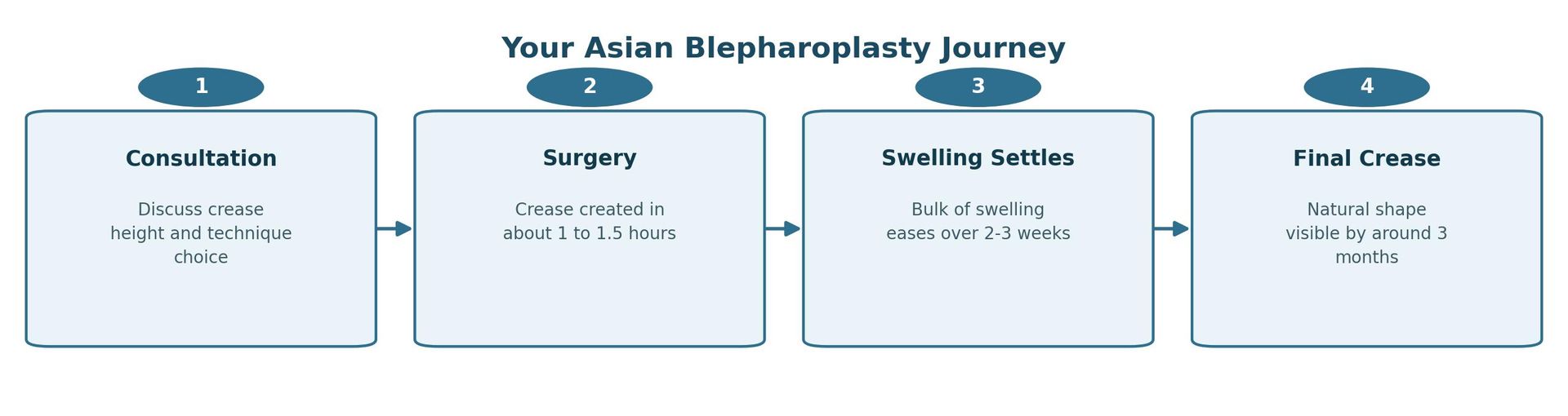
• Usually performed under local anaesthesia, taking about 1 to 1.5 hours
• Swelling is often more pronounced than other eyelid procedures, especially in the first week
• Sutures, if used for the incisional method, are typically removed at 5 to 7 days
• The crease can look uneven or too high initially due to swelling — this settles with time
• Rubbing the eyes and wearing eye makeup should be avoided during early healing
• The final crease shape is usually clear by around 3 months
COMPLICATIONS AND MANAGEMENT
Swelling tends to be more noticeable with this surgery than with standard blepharoplasty, and there are some risks specific to creating a new crease.
• Significant swelling and bruising in the first one to two weeks
• Asymmetry between the two eyelid creases
• Crease loss or loosening over time, more common with the suture method
• A crease that looks too high, too low, or unnatural for the eyelid
• Visible scarring, particularly with the incisional method
• Temporary dry or irritated eyes during healing
• Infection (uncommon)
• Possible need for revision surgery if the crease does not hold or settle evenly
FAQs
Suture or incisional method — which is better?
It depends mainly on how much excess skin or fat is present. The suture method is less invasive and suits thinner eyelids, but is generally less durable; the incisional method is more reliable for eyelids with more tissue to address.
Will my eyes look unnatural or 'westernised'?
The goal is a crease that is proportionate to your own eyelid and face, not a fixed foreign look. Most people aim for, and achieve, a natural-looking result rather than a dramatically different eye shape.
How long until the swelling goes down?
Most of the swelling resolves within two to three weeks, though subtle swelling can linger for up to three months while the final crease shape settles.
Is this reversible?
Not really, particularly with the incisional method. The suture method can sometimes be revised or may loosen naturally, but it is best to approach this as a largely permanent decision.
What age is appropriate?
This is usually done in adulthood, though some surgeons will see older teenagers with parental involvement once the eyelid has finished developing.
Is it very painful?
Most people find it more uncomfortable due to swelling and tightness than truly painful, and this is manageable with simple pain relief in the first few days.