FACE LIFT
Dr Chia Hui Ling
A face lift, medically known as rhytidectomy, addresses sagging skin and the deeper tissue beneath it in the lower face and neck. As the skin loses elasticity and the underlying support structures descend with age, this often shows up as jowls along the jawline, deepened folds beside the mouth, and loose skin under the chin. A face lift repositions these tissues to restore a firmer, more natural contour.
• Softens jowls and re-defines the jawline
• Reduces loose, hanging skin along the lower face and neck
• Addresses deeper support structures, not just the skin, for a more natural and durable result
• Can be paired with less invasive techniques for a fuller but still balanced correction
• Moderate to significant skin and soft-tissue laxity that hasn't responded well to non-surgical treatments
• Good general health and realistic expectations about recovery time
• Concerns concentrated in the lower face and neck, rather than fine lines or sun damage alone
• An interest in a longer-lasting result than injectables or energy-based treatments can offer
A face lift is a significant undertaking rather than a quick fix, and it does not stop the ageing process — it resets the visible signs of sagging at the time of surgery, and results continue to depend on your skin, technique used, and healing.
TREATMENT
There is more than one way to lift the face, and the right technique depends on how much sagging is present, which areas concern you most, and how much downtime you can accommodate.
• Traditional (full) face lift: incisions run along the hairline at the temple, in front of and behind the ear, allowing the surgeon to reposition the deeper SMAS layer as well as the skin — the most thorough option for significant jowling and neck laxity
• Endoscopic face lift: a small camera (endoscope) is passed through a few short incisions hidden in the hairline, letting the surgeon lift and reposition deeper tissue without a long incision — well suited to earlier signs of ageing, the brow and mid-face, and those who want less visible scarring and a quicker recovery, though it addresses less skin excess than a traditional lift
• Mini or limited-incision lift: a shorter version of the traditional incision, used for more moderate sagging concentrated around the jawline
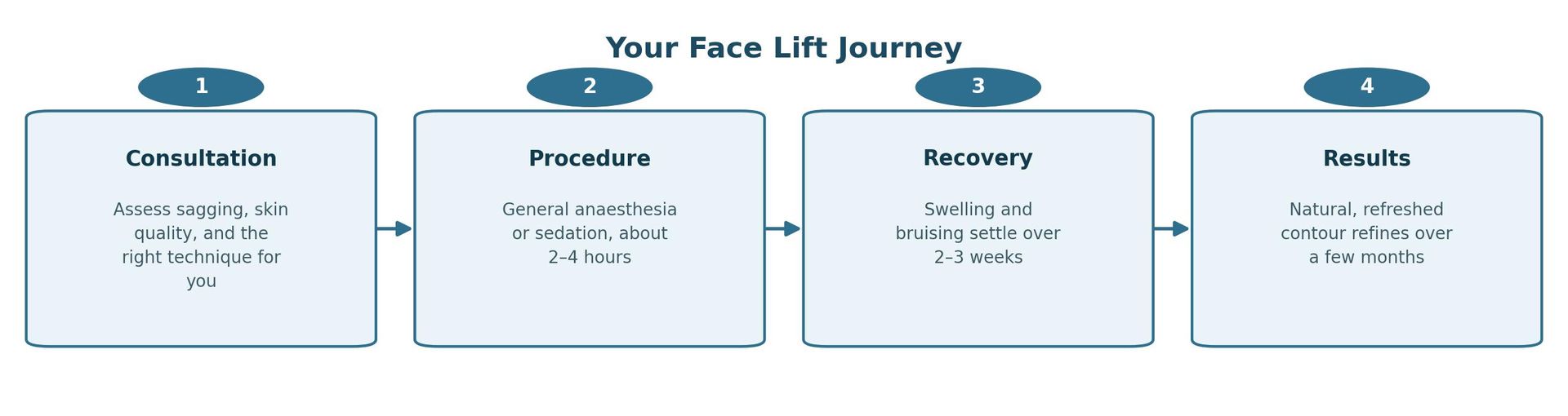
• Surgery is usually done under general anaesthesia or deep sedation with local anaesthesia, and is typically day surgery with at least one night of observation, though some practices perform it as day surgery
• Small drainage tubes may be placed temporarily to reduce fluid build-up
• A supportive dressing or compression garment is typically worn for the first several days
• Sutures or clips are usually removed within one to two weeks
• Surgery itself commonly takes two to four hours, depending on the extent of the procedure and whether it is combined with other treatments
Initial swelling and bruising are most noticeable in the first one to two weeks, with most people feeling comfortable returning to non-strenuous daily activities and light social activity within two to three weeks, once obvious bruising has faded. Residual swelling and tightness can take several weeks to a few months to fully settle, and final results continue to refine over that period.
FAQs
How much of the injected fat actually survives?
This varies from person to person, and a portion is always reabsorbed by the body in the first few months. What remains after that point, typically assessed around three to six months, is generally considered fairly stable long-term.
Is fat grafting safer than synthetic fillers?
Using your own tissue avoids the small risk of allergic reaction associated with some synthetic fillers, but fat grafting carries its own distinct risks, including donor site issues and fat necrosis. It is a different risk profile rather than simply a safer one.
How long does the procedure take?
Most facial fat grafting procedures take one to two hours, depending on how many areas of the face are being treated.
Will I need touch-up sessions?
Some people do, particularly if they want to fully replace the volume that is reabsorbed during initial healing. This is usually planned as a possibility from the outset rather than a sign anything went wrong.
Where does the fat come from?
Commonly the abdomen, thighs, or flanks, wherever there is adequate donor fat available and convenient to access.
How soon will I see the final result?
Initial swelling makes the area look fuller than the eventual result, so it is best to judge the outcome only once swelling has settled, typically around three to six months later.
COMPLICATIONS AND MANAGEMENT
What's the real difference between a traditional and an endoscopic face lift?
A traditional face lift uses longer incisions to reposition both skin and deeper tissue, making it the more thorough option for significant sagging. An endoscopic face lift uses a few short, hidden incisions and a small camera to lift deeper tissue without a long scar, which suits earlier, milder signs of ageing better than advanced jowling or loose neck skin.
Am I too young, or too old, for a face lift?
There isn't a fixed age — it depends more on how your skin and tissues have aged than the number on your birth certificate. Some people benefit from an endoscopic or mini lift in their 40s or 50s, while a traditional lift is often more appropriate for more advanced sagging later on.
Will people be able to tell I've had it done?
A well-planned face lift is meant to look like a refreshed, more rested version of you, not a different face. That said, swelling in the first couple of weeks can look more dramatic than your final result, so it's worth planning your timing around this.
How long do the results last?
Results are genuinely long-lasting, often a decade or more, but your face continues to age afterwards, so gradual changes will still occur. Maintaining skin quality with sun protection and skincare can help results age well.
Can this be combined with a neck lift or eyelid surgery?
Yes, it's common to combine a face lift with a neck lift, eyelid surgery, or fat grafting for a more balanced overall result. Combining procedures can also mean a single recovery period rather than several.
How much downtime should I plan for?
Most people take about two to three weeks off work and social occasions, though this varies with the technique used and how your body heals. Full settling of swelling and final results takes a few months.