BREAST RECONSTRUCTION
Rebuilding, Restoring, and Moving Forward
Author: Dr Chia Hui Ling
A guide to your options
If you're facing a mastectomy or lumpectomy, reconstruction is not something you have to figure out alone or decide on overnight.
Breast reconstruction is one of the most refined and well-studied areas of plastic surgery. Techniques have advanced enormously over the past two decades, and today's options can restore not just breast shape, but sensation, symmetry, and confidence.
Whatever you choose — and whenever you choose it — visit an accredited plastic reconstructive surgeon experienced in breast reconstruction and you will be supported by a team trained specifically for this.
What Is Breast Reconstruction?
Breast reconstruction is surgery to rebuild the shape, size, and appearance of the breast after it has been partly or fully removed, most often due to breast cancer treatment or genetic risk-reducing surgery. It can use breast implants, your own body tissue, or a combination of both.
Reconstruction is entirely your choice. Most patients reconstruct immediately, some wait months or years, and some choose not to reconstruct at all and opt for "flat closure" — all of these are medically valid, well-supported paths. There is no wrong answer, only the one that is right for you.
Your Reconstruction Options
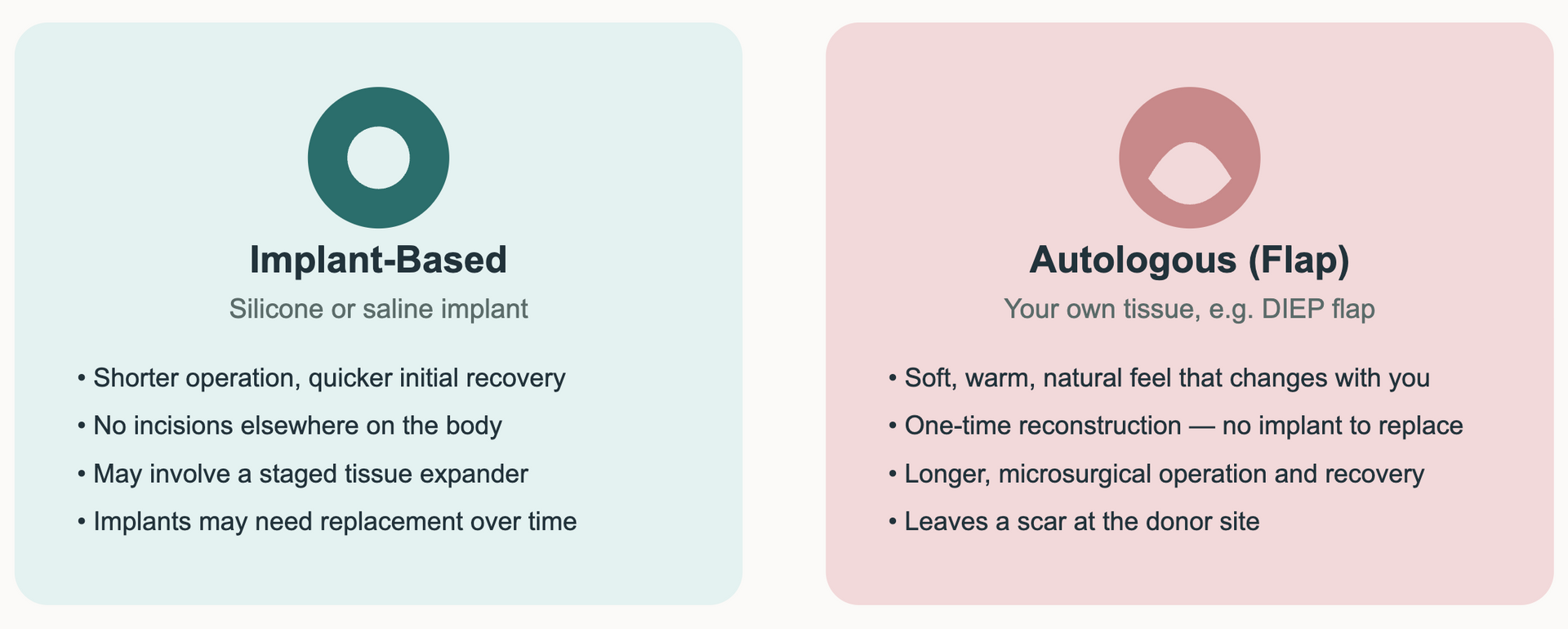
There are two main approaches to rebuilding the breast. Many patients also combine elements of both, and your surgeon will help match the option to your body, treatment plan, and goals.
When Does Reconstruction Happen?
Reconstruction can begin at the same time as your cancer surgery, or well afterward — the choice is yours. Although majority of reconstruction are performed are immediate reconstructions, delaying reconstruction does not mean missing your window.
Your oncology and plastic surgery teams work together throughout, so reconstruction is coordinated safely around chemotherapy, radiation, or other treatment — it will not compromise your cancer care.

Beyond Breast Shape:
Procedures That Protect and Restore
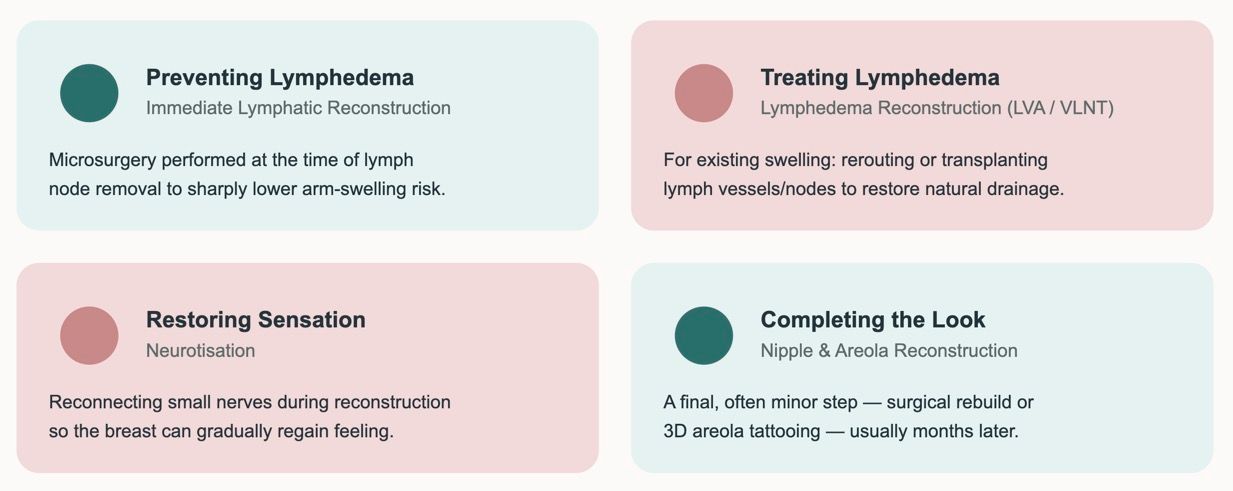
Modern reconstruction goes further than rebuilding a breast mound. A number of ancillary procedures — often performed alongside your main reconstruction — can protect your arm from swelling, restore feeling, and complete a natural-looking result.
Preventing Lymphedema Before It Starts
If lymph nodes need to be removed from your armpit, fluid can sometimes build up in the arm afterward — a condition called lymphedema. Immediate Lymphatic Reconstruction (ILR), also known as LYMPHA, is a microsurgical technique performed at the same time as your lymph node removal. Surgeons reconnect small lymphatic channels directly into nearby veins so fluid keeps draining normally. Studies following patients over time have shown this can reduce the risk of lymphedema several-fold compared with no prevention — a meaningful, proactive step you can take at the very start of your treatment.
Treating Lymphedema, If It Develops
If swelling has already developed — even years after treatment — it is not something you have to simply live with. Lymphedema reconstruction, using techniques such as lymphovenous anastomosis (LVA) or vascularized lymph node transfer (VLNT), reroutes or rebuilds your lymphatic drainage. Research shows meaningful reductions in swelling and fewer infections for many patients, along with less reliance on compression garments.
Restoring Sensation: Neurotisation
A reconstructed breast can look natural but feel numb, since mastectomy cuts through the nerves that once carried sensation. Neurotisation reconnects a sensory nerve to the reconstructed breast during surgery, giving nerves a pathway to gradually regrow. Patients who undergo neurotisation report better sensation and higher satisfaction with their quality of life — it's a technique worth discussing with your surgeon regardless of which reconstruction option you choose.
Completing the Picture: Nipple & Areola Reconstruction
Once your reconstructed breast has settled — usually a few months later — you can choose to recreate the nipple and areola. This can be done surgically, using a small local flap of your own skin to create natural projection, and/or with specialist
3D areola tattooing, which uses shading and colour to create a remarkably realistic appearance without further surgery. Many patients combine both. This step is entirely optional and there is no deadline to decide.
What to Expect: Recovery
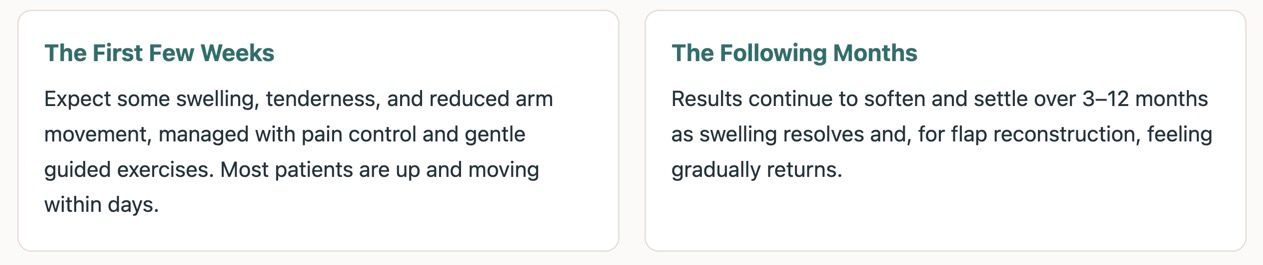
Every recovery is different, and your surgical team will give you a personalised timeline. What's consistent across the evidence is this: complication rates for modern reconstruction are low, techniques are continually refined, and most patients describe reconstruction as a meaningful part of moving forward after cancer treatment.
FREQUENTLY ASKED QUESTIONS
Will reconstruction delay my cancer treatment or hide a recurrence?
No. Reconstruction is carefully coordinated with your oncology team, and studies show it does not interfere with cancer treatment or with detecting a recurrence.
Will it actually look and feel natural?
Modern techniques — including autologous flaps and neurotisation — are specifically designed to achieve a natural look, feel, and even sensation over time. Results keep improving as these techniques advance.
Do I have to decide everything right away?
Although immediate reconstruction gives better outcomes in terms of physical and mental well-being, it is never too late. You can reconstruct immediately, delay it, stage it over multiple smaller procedures, or decide not to reconstruct at all. Every path is valid, and you can change your mind as you learn more.
Is reconstruction just cosmetic?
No. In many countries, breast reconstruction is recognised as a medically necessary part of breast cancer treatment, and coverage requirements reflect this. Ask your care team or insurer about what applies where you live.
You are not on your own with this decision.
Plastic surgeons who focus on breast reconstruction do this every day, alongside oncologists, breast surgeons, and breast care nurses who understand what you're going through.
Bring your questions, your worries, and your timeline — there is a plan that can be built around you.