ARM LIFT (BRACHIOPLASTY)
An arm lift, or brachioplasty, tightens loose, sagging skin on the upper arm, most often seen after significant weight loss or as part of natural ageing. It trades a long scar for a firmer, smoother arm contour, so it suits people for whom skin laxity, not fat, is the main concern.
• Removes excess, hanging skin along the inner and back of the upper arm
• Creates a smoother, more defined arm contour
• Can improve comfort and reduce chafing during exercise or daily movement
• Often improves how clothing, particularly sleeveless tops, fits and sits
• Can be combined with liposuction to refine remaining fatty areas
• Noticeable loose or crepey skin on the upper arms that does not respond to exercise
• Weight has been stable for several months, often after major weight loss
• Non-smokers, or willing to stop well before and after surgery
• In good general health with realistic expectations about scarring
• Understand that arm strength itself is not typically changed by this operation
The trade-off is real: this surgery leaves a scar that runs most of the length of the inner arm. For those bothered daily by loose skin, most find this an acceptable exchange, but it is worth sitting with that decision before committing.
TREATMENT
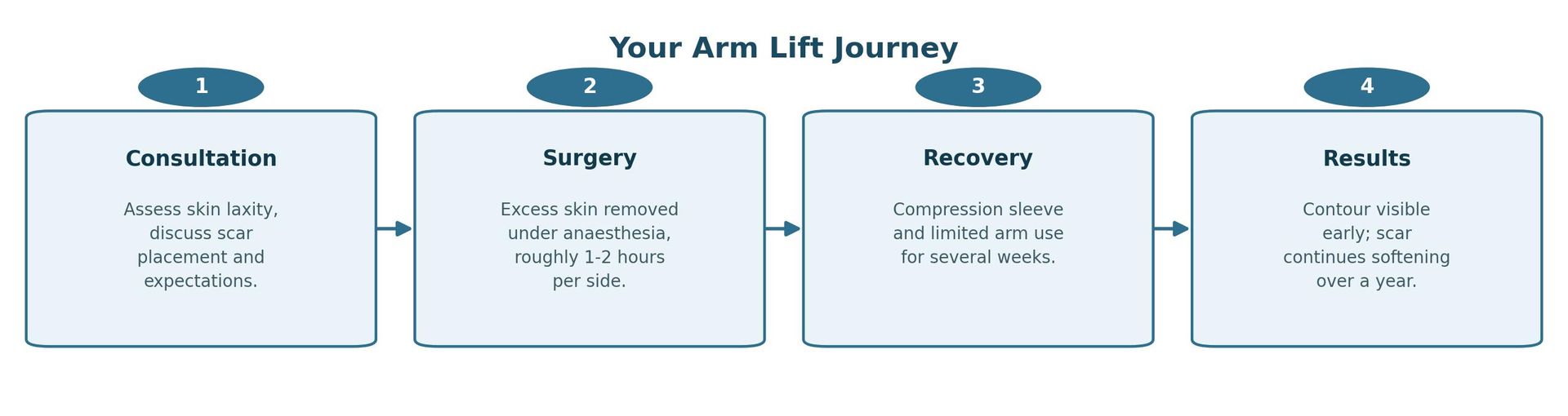
Brachioplasty is usually performed under general anaesthesia, or occasionally local anaesthesia with sedation for more limited cases, and takes roughly one to two hours per side depending on how much skin needs removing.
• An incision is made along the inner arm, from near the elbow towards the armpit, with its length matched to how much skin needs removing
• For milder laxity, a shorter 'mini' incision limited to the area near the armpit may be enough
• Excess skin is excised and the remaining tissue is tightened
• Liposuction may be performed at the same time to reduce residual fat
• A small drain may be left in for a few days to reduce fluid build-up
• First 1-2 weeks: compression sleeve worn most of the time, arms kept elevated when resting, light daily activities only
• 2-4 weeks: gradual return to normal arm use for daily tasks, still avoiding heavy lifting
• 4-6 weeks: gradual return to upper body exercise, guided by your surgeon
• Scarring is initially firm and red, softening and fading over 12 months or more
COMPLICATIONS AND MANAGEMENT
Arm lift surgery is generally well tolerated, but the following risks are worth discussing with your surgeon beforehand.
• A long, sometimes prominent scar that can thicken or widen, particularly in those prone to raised scarring
• Wound healing delays, especially near the elbow or armpit where skin tension is highest
• Areas of numbness or altered sensation along the inner arm, usually improving over months
• Fluid collection under the skin (seroma) requiring drainage
• Infection, usually treatable with antibiotics
• Swelling of the hand or arm from disruption to small lymphatic channels (uncommon but can persist)
• Asymmetry between the two arms
• Rarely, injury to a nearby nerve causing temporary or, very rarely, lasting weakness or numbness
FAQS
How visible will the scar be?
The scar sits on the inner arm and is quite noticeable in the first year, typically starting red and firm before gradually fading and softening. Most people find it acceptable given how much it improves arm contour, but it does not disappear entirely.
Is the surgery painful?
Most patients describe soreness and tightness rather than sharp pain, particularly when moving the arms in the first week. This is manageable with prescribed pain medication and eases steadily.
When can I return to work?
Desk-based work is usually possible after about one to two weeks, while jobs involving lifting or repetitive arm movement often need four to six weeks.
Will this affect my arm strength?
The muscles themselves are not altered, so strength is generally unaffected once healing is complete, though the arm may feel stiff or tender in the early weeks.
Is liposuction alone an alternative?
Liposuction removes fat but cannot tighten loose or crepey skin. If skin laxity is the main issue, liposuction alone will leave the excess skin behind.
Who is not a good candidate?
Those with only mild skin looseness, or whose weight is not yet stable, are often better served by waiting or considering non-surgical options, since surgery trades a long scar for tightening that may not be needed yet.