THIGH LIFT
Dr Chia Hui Ling
A thigh lift removes loose, sagging skin from the thighs, most commonly after major weight loss but also seen with ageing or as part of a body contouring plan. Because thigh skin is thin and the area sees constant movement, this is a procedure where realistic expectations about scarring matter as much as the contour result itself.
• Removes excess, hanging skin on the inner and sometimes outer thigh
• Creates a smoother, firmer thigh contour
• Can reduce chafing and skin irritation between the thighs
• Often improves how trousers, skirts, and swimwear fit
• Can be combined with liposuction to refine remaining fat
• Noticeable loose thigh skin that does not respond to exercise, often after significant weight loss
• Weight has been stable for several months
• Non-smokers, or willing to stop well before and after surgery
• In good general health with realistic expectations about scar length and position
• Comfortable with a scar that may sit in the groin crease and, for larger corrections, extend down the inner thigh
This is a procedure where the scar trade-off is significant, and unlike some other body contouring scars, thigh lift scars sit in an area of friction and movement, which can affect how well they settle.
TREATMENT
PROCEDURE
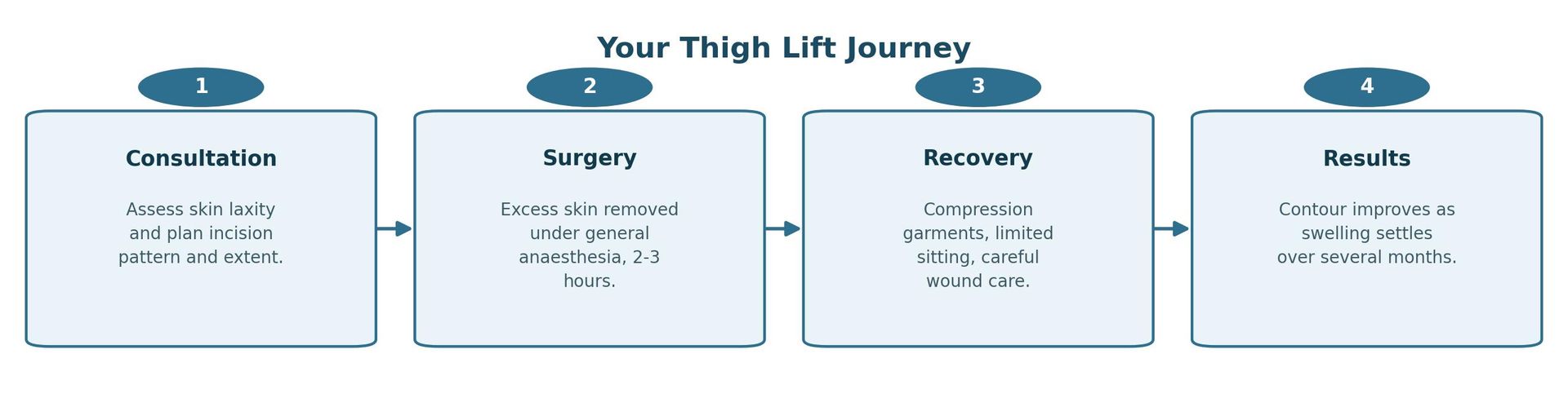
Thigh lift technique depends on how much skin needs removing and where the laxity is worst. It is performed under general anaesthesia, typically taking two to three hours.
• An inner (medial) thigh lift uses an incision in the groin crease, sometimes extended down the inner thigh for more significant excess skin
• An outer thigh lift, often combined with a lower body lift, addresses the outer thigh and hip area through a higher incision
• Excess skin and fat are removed and the deeper tissue is anchored to reduce tension on the scar
• Liposuction may be used at the same time to smooth surrounding areas
• Drains are commonly placed for several days to reduce fluid build-up
• First 1-2 weeks: limited walking, compression garments worn continuously, avoiding sitting for long periods to reduce groin wound tension
• 2-6 weeks: gradual increase in walking and daily activity, still avoiding strenuous exercise
• 6-8 weeks: gradual return to full exercise, guided by your surgeon
• The groin area stays moist and is under tension when walking, wound healing here often takes longer than in other body contouring surgery
FAQs
Where exactly will the scar be?
For an inner thigh lift it usually sits in the groin crease, sometimes extending down the inner thigh if more skin needs removing. It is genuinely a longer, more visible scar than many other body contouring procedures, and this is worth weighing carefully.
Why does this heal more slowly than other body lifts?
The groin area stays warm and moist and experiences friction with walking, which makes wound healing less predictable than in drier, less mobile areas. Following wound care instructions closely makes a real difference.
Is this the same as liposuction?
No. Liposuction removes fat but cannot address loose or sagging skin, which is the main problem a thigh lift is designed to treat.
How long before I can sit comfortably?
Most people manage short periods of sitting within the first week but are advised to avoid prolonged sitting for two to three weeks to reduce tension on the groin incision.
Can this be combined with a tummy tuck or lower body lift?
Yes, and for people with widespread skin laxity after major weight loss this is often planned as part of a staged approach, though combining procedures increases surgical time and recovery demands.
Will exercise afterwards affect the result?
Regular exercise supports overall body tone but will not address remaining loose skin, since skin elasticity does not fully respond to muscle tone. Maintaining a stable weight is what best protects the result.
COMPLICATIONS
Thigh lift surgery carries a somewhat higher rate of wound healing issues than many other body contouring procedures, largely due to the location of the incisions.
• Wound healing delays or wound separation, particularly in the groin where skin is under tension and moisture
• Scarring that can widen, thicken, or migrate downward over time
• Fluid collection under the skin (seroma)
• Infection, sometimes requiring prolonged wound care
• Areas of numbness along the inner thigh, usually improving over months
• Swelling of the lower leg from disruption to lymphatic channels, occasionally persistent
• Asymmetry between the two thighs
• Blood clots in the legs, a reason early gentle walking is encouraged despite wound tension