BROW LIFT
Dr Chia Hui Ling
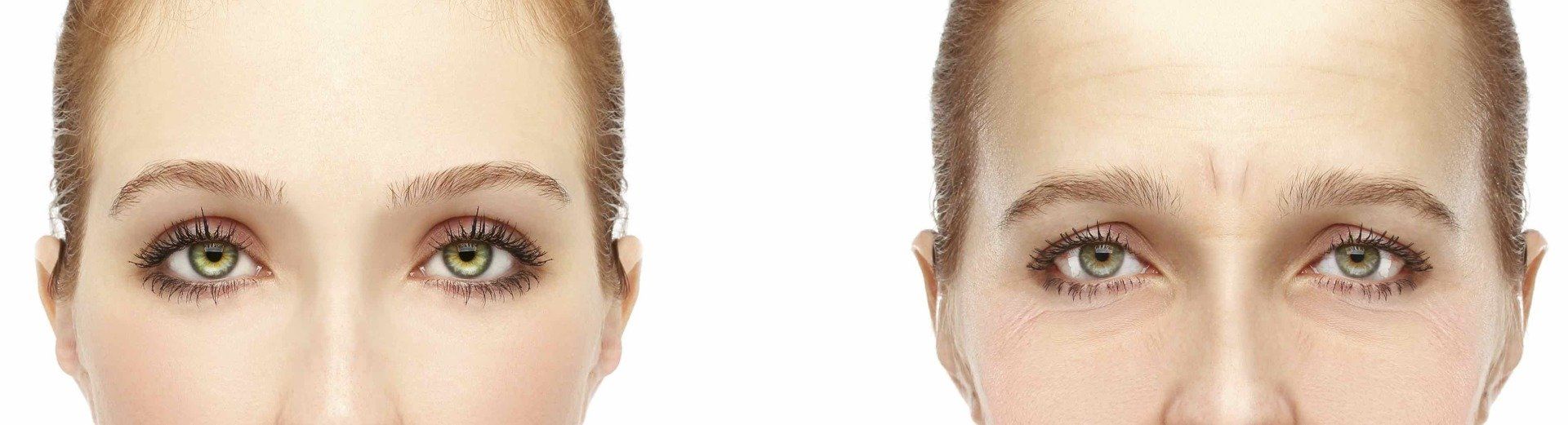
A brow lift repositions sagging eyebrows and softens deep forehead lines, opening up the upper part of the face. For many people, a heavy or drooping brow is what makes them look tired, stern, or older than they feel — often more so than any single line or wrinkle.
• Raises drooping or heavy brows to a more youthful position
• Softens horizontal forehead furrows and the frown lines between the brows
• Opens up the eye area, which can reduce a tired or sad resting expression
• Can reduce the appearance of hooded upper eyelids caused by brow descent
• Results are generally long-lasting compared with non-surgical options
• Visible brow heaviness or sagging that affects the upper eyelid area
• Deep, static horizontal forehead lines
• A tired, sad, or angry resting expression caused by low brow position
• Reasonably good skin elasticity and overall health
• Realistic expectations about a natural, not overly raised, result
A brow lift changes brow position and forehead tone — it does not erase every fine line, and it is not a substitute for addressing loose upper eyelid skin, which may need its own treatment. It is often considered alongside blepharoplasty for a more complete result around the eyes.
TREATMENT
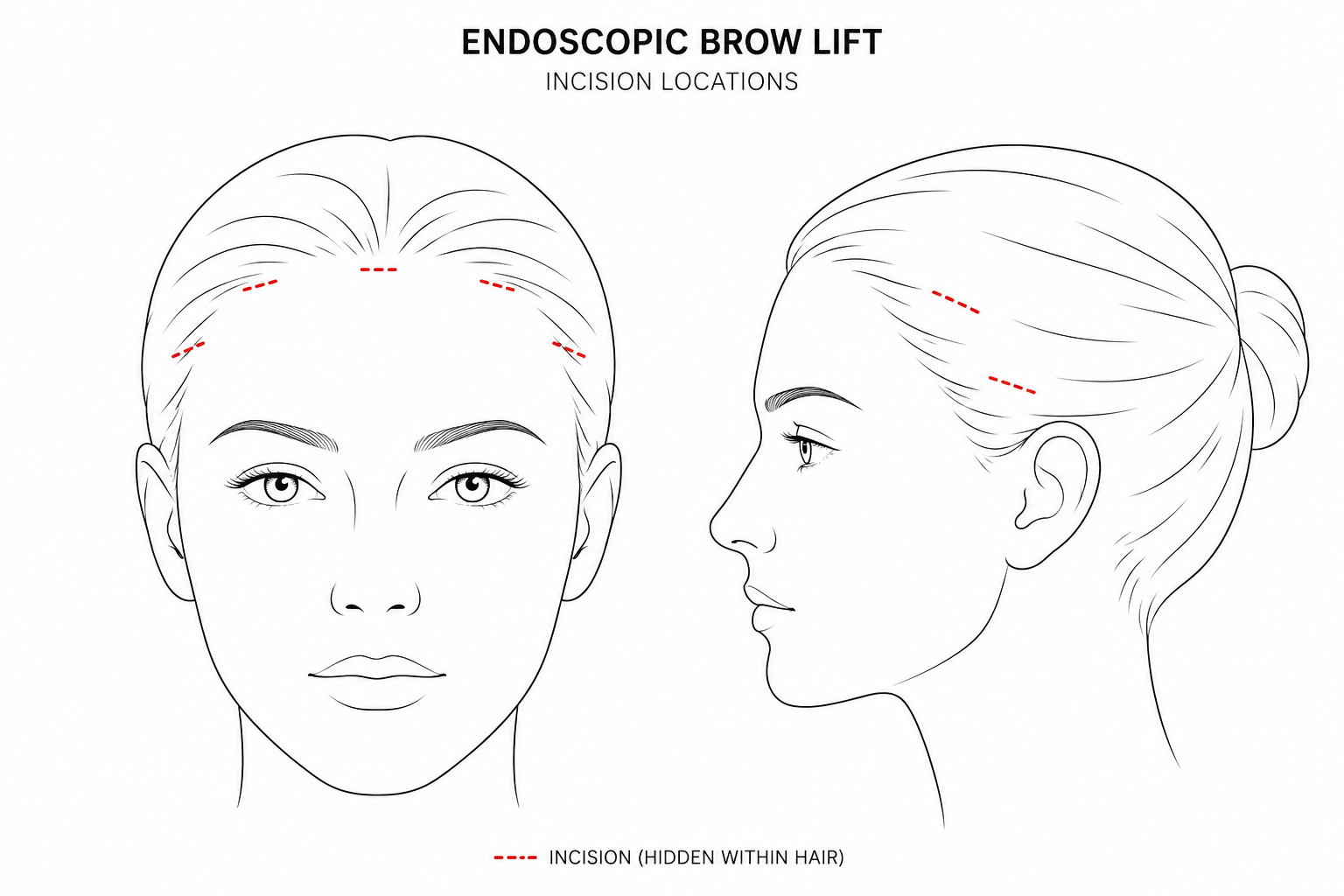
The most common modern approach is an endoscopic brow lift, using a small camera through a few short incisions hidden within the hairline to reposition the brow and forehead tissue, which is then secured with sutures or small fixation devices. A temporal (lateral) lift, addressing just the outer brow, is sometimes suitable for a more limited concern. It can be performed under general anaesthesia or local anaesthesia with sedation. The choice of technique depends on how much of the brow and forehead needs repositioning, and whether forehead muscle activity contributing to lines also needs to be softened.
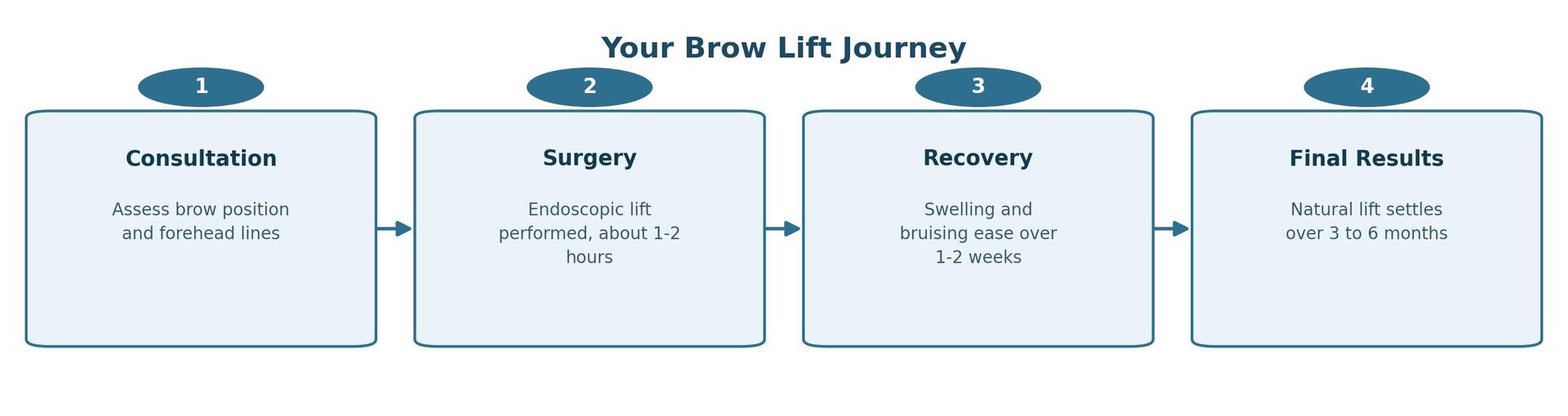
• Surgery typically takes 1 to 2 hours
• Incisions are small and hidden within the hairline
• Swelling and bruising are common for the first 1 to 2 weeks
• Temporary numbness, tightness, or itching of the scalp is normal during healing
• Strenuous exercise and heavy lifting should be avoided for 2 to 4 weeks
• Final results become apparent over 3 to 6 months as residual swelling settles
Most people take about a week off work, though some swelling and mild scalp sensitivity can linger longer.
COMPLICATIONS AND MANAGEMENT
As with any surgery involving the forehead and scalp, there are risks worth understanding before proceeding.
• Bruising and swelling around the forehead and eyes
• Temporary numbness, tingling, or itching of the scalp
• Asymmetry between the two brows
• Overcorrection, giving a permanently surprised or overly raised appearance
• Temporary hair thinning near the incision lines, usually regrowing
• Nerve injury affecting brow movement or sensation (uncommon, occasionally prolonged)
• Visible scarring, though incisions are designed to be hidden in the hairline
• Results that do not last as long as hoped, particularly if skin quality is poor
FAQs
How long do brow lift results last?
Many people enjoy the results for five to ten years or longer, since it involves surgically repositioning tissue rather than a temporary treatment. Natural ageing continues, though, so the brow will gradually descend again over time.
Will I look permanently surprised?
That is a real risk if the brow is lifted too aggressively, which is why a conservative, natural-looking lift is usually the goal. A skilled assessment of how much lift suits your face helps avoid an overdone look.
Can a brow lift fix hooded eyelids?
It often improves hooding that is caused by a low brow pressing down on the eyelid, but if there is also excess eyelid skin itself, you may still need eyelid surgery for full correction.
Will the scars be visible?
Incisions are placed within the hairline and are typically thin and well hidden once healed, though this can be a consideration for people with very thin or receding hair.
How much downtime should I plan for?
Most people take about one to two weeks off work and social activities, with swelling and scalp sensitivity sometimes persisting a little longer.
Can it be combined with other facial procedures?
Yes, a brow lift is commonly combined with upper eyelid surgery or a facelift for a more comprehensive rejuvenation, discussed together during consultation.