CHIN SURGERY
Dr Chia Hui Ling
Chin surgery reshapes a chin that is weak and recessed, overly prominent, or asymmetric, to bring better balance to the lower face and profile. The chin has an outsized effect on how the whole face reads in profile, so even a modest change here can noticeably improve overall facial harmony.
• Improves facial profile and balance, especially in relation to the nose
• Can sharpen jawline definition and reduce the appearance of a 'weak chin' look
• Corrects chin asymmetry
• Implant augmentation is reversible; bony surgery (genioplasty) offers a more permanent structural change
• Often paired with rhinoplasty when both nose and chin affect the same profile balance
• A chin that appears weak, recessed, or disproportionately small for the face
• An overly prominent or asymmetric chin
• Good dental and jaw health (a dental assessment is sometimes needed beforehand)
• Realistic expectations of a proportion change rather than a completely different face
• Adults whose facial growth and bone development are complete
• Double chin reduction using liposuction techniques further enhances the contour of the chin and jawline.
Chin changes often make more difference to your side profile than to how you look straight on, which can be worth remembering when picturing the result. Because the chin, jaw, and neck all influence each other visually, a full facial assessment is usually more useful than looking at the chin in isolation.
Double chin reduction using liposuction techniques further enhances the contour of the chin and jawline.
TREATMENT
Three main approaches exist:
A chin implant, usually silicone, is placed through a small incision under the chin or inside the mouth, and is comparatively simple and can be removed or exchanged later.
A sliding genioplasty involves surgically cutting and repositioning the chin bone itself, fixed with a small plate and screws — more versatile for larger or multi-directional changes, but a more involved recovery.
Chin reduction, shaving down bone, suits an overly prominent chin. These are done under local anaesthesia with sedation or general anaesthesia depending on complexity.
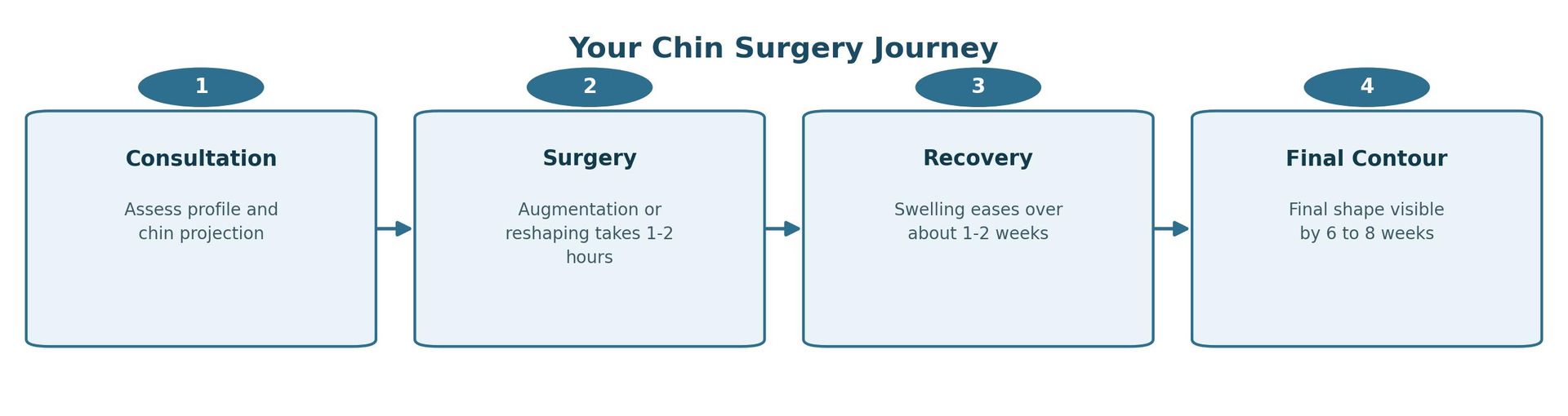
• Implant surgery takes about 45 minutes to an hour; genioplasty typically 1 to 2 hours
• Swelling and bruising are common for 1 to 2 weeks
• A soft diet is often recommended for the first few days, especially with an intraoral incision or bony surgery
• Temporary numbness of the chin or lower lip is common during healing
• Return to work is typically about 1 to 2 weeks for implants, and 2 to 3 weeks for bony surgery
• Final contour is usually visible by 6 to 8 weeks, though subtle swelling from bony surgery can take longer
COMPLICATIONS AND MANAGEMENT
Risks differ somewhat depending on whether an implant or bone reshaping is used.
• Swelling and bruising
• Temporary numbness of the chin or lower lip, occasionally prolonged
• Asymmetry
• Implant malposition or shifting over time (implant-specific)
• Implant extrusion or palpability under thin skin (implant-specific)
• Infection
• Nerve injury causing longer-lasting numbness or lip weakness (uncommon)
• Bone healing issues, such as delayed union, with genioplasty
• An aesthetic result that does not meet expectations, occasionally requiring revision
FAQs
Implant or bone surgery — which is better?
It depends on how much correction is needed. An implant is simpler and reversible, suited to smaller projection changes, while a sliding genioplasty offers more flexibility for larger or multi-directional adjustments, at the cost of a more involved recovery.
Will my lip feel numb afterward?
Temporary numbness of the chin or lower lip is common because of a nerve that runs close to the surgical area. Most people regain normal sensation over several weeks to a few months.
How long is recovery?
Most people plan for about one to two weeks of social downtime, with several more weeks of residual swelling before the final shape is fully visible.
Is the change permanent?
A genioplasty is a permanent change to your own bone structure. Implants can be removed or exchanged later if your preferences change.
Can it be combined with jawline or neck procedures?
Yes, chin surgery is often combined with neck liposuction or jawline contouring, since these areas work together visually.
Will it affect my teeth or bite?
Genioplasty is planned carefully to avoid the tooth roots and bite, and your dental and orthodontic history is usually discussed as part of planning.