
HYBRID BREAST AUGMENTATION
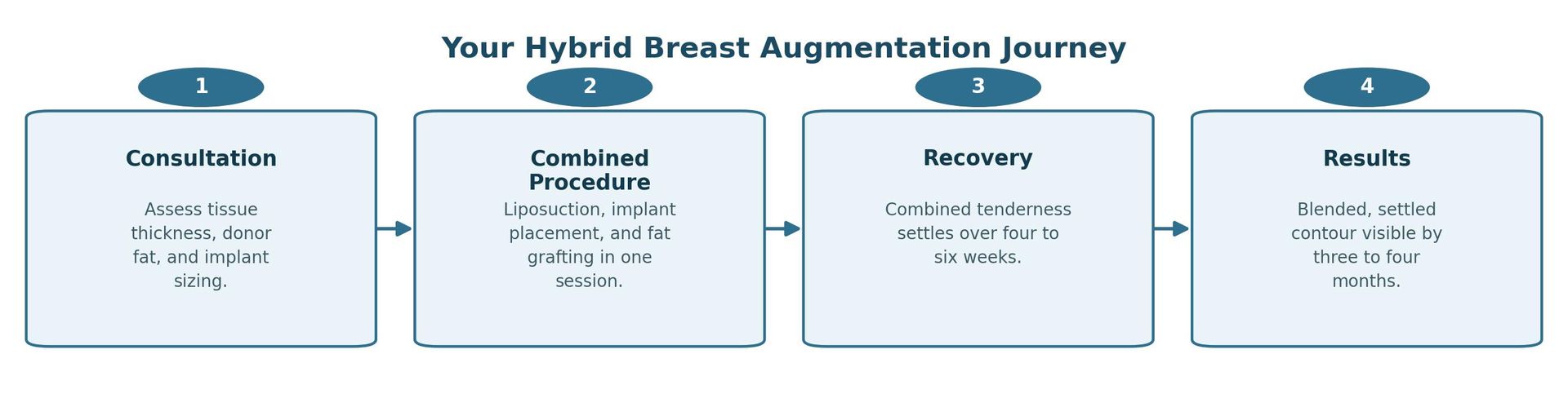
Hybrid breast augmentation combines an implant with fat grafting in the same procedure. The implant provides the bulk of the volume increase, while fat is used to add a soft layer over the implant edges and upper chest, softening the transition between implant and natural tissue.
• Gives a more natural-feeling contour than an implant alone, particularly in the upper breast and cleavage area
• Camouflages implant edges and rippling in people with thin natural tissue coverage
• Allows a smaller, more conservative implant to be used, since fat fills out the shape
• Improves the transition zone between chest wall and breast, which can look and feel more gradual
• You are relatively thin with limited natural breast tissue, where implants alone tend to show edges or rippling
• You want the volume that only an implant can reliably give, combined with a softer, more natural finish
• You have adequate donor fat available for grafting
• You accept a longer, more complex surgery and recovery than either procedure alone
This is a refinement technique rather than a shortcut, and the added complexity means it is not necessarily the right choice for every patient considering augmentation
TREATMENT
FAQs
Why choose hybrid over a regular implant?
It is usually chosen by people with thin tissue coverage who want to avoid visible implant edges or rippling, or who want a softer, more gradual contour than an implant alone can give.
Does this take longer than a standard augmentation?
Yes, because it combines liposuction, fat processing, and implant placement in one session, surgery time and recovery are both somewhat longer.
How much extra volume does the fat add?
Fat grafting in this context is mainly for contour and camouflage rather than significant size increase, typically adding a subtle amount of volume on top of what the implant provides.
Is recovery harder than implants alone?
Recovery is a bit more uncomfortable in the first one to two weeks because of the added liposuction sites, but it follows a similar overall timeline.
Will I need a touch-up fat session later?
Occasionally, if fat survival is uneven or a patient wants further refinement, a smaller secondary fat grafting session can be done later.
Am I a candidate if I am not thin?
It can still be an option, but the main advantage over a standard implant is most noticeable in people with less natural tissue to begin with.
COMPLICATIONS AND MANAGEMENT
Because this technique combines two procedures, it carries the risks of both, and the overall complication profile is a little higher than either alone.
• Capsular contracture, implant rupture, or rippling, as with any implant-based augmentation
• Fat necrosis, oil cysts, or uneven fat survival at the grafted areas
• Asymmetry if fat take or implant position differs between sides
• Longer, more tender recovery than a single technique
• Infection or bleeding, though uncommon
• A small chance that a second procedure is needed to refine the result