LOWER EYELID SURGERY
Dr Chia Hui Ling
Lower eyelid surgery, or lower blepharoplasty, addresses the puffiness, hollowing, or loose skin that can make the area under the eyes look tired, aged, or 'baggy' regardless of how much sleep you've had. Because the lower lid sits right at the junction between the eye and the cheek, a good result usually depends on treating that whole transition, not just the eyelid skin in isolation.
• Softens under-eye bags caused by protruding fat pads
• Smooths hollow tear-trough shadows that can make you look perpetually tired
• Tightens loose or crepey lower lid skin
• Blends the lid-cheek border into one smooth curve rather than a visible step
• Persistent under-eye puffiness that isn't related to allergies, sleep, or fluid retention
• A hollow, shadowed groove under the eyes (the tear trough)
• Loose lower lid skin with fine wrinkles
• Realistic expectations, since this area heals slowly and benefits from a conservative, staged approach if needed
The best plan is rarely one-size-fits-all here — how much is fat, how much is hollowing, and how much is the cheek itself starting to descend all change what a surgeon would recommend.
TREATMENT
Lower eyelid surgery can be approached from inside or outside the lid, and is increasingly about repositioning and adding volume rather than simply cutting things away.
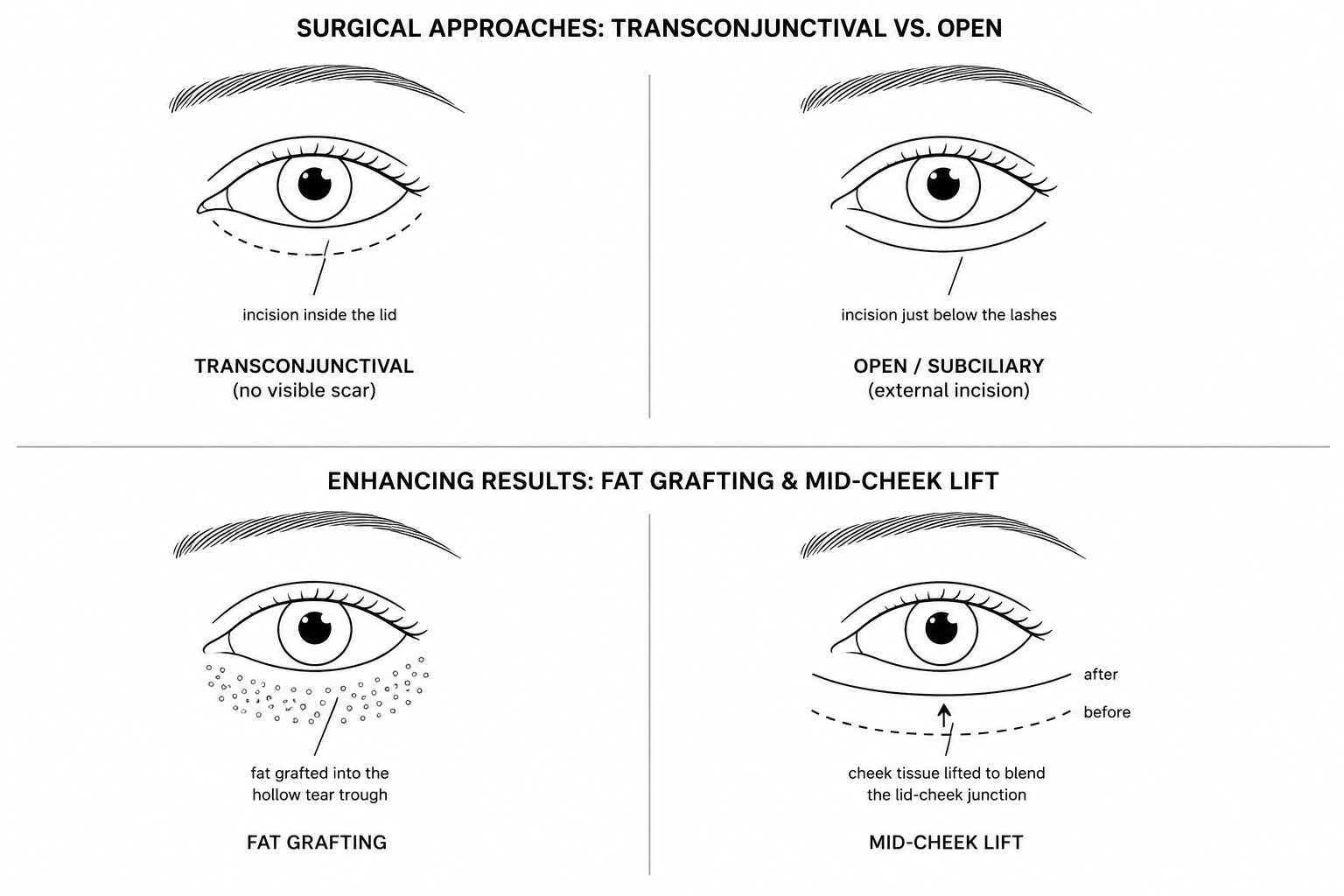
• Transconjunctival approach: the incision is placed inside the lower lid, leaving no visible external scar — well suited to repositioning or removing fat in people with reasonable skin tone, without addressing excess skin
• Open (subciliary) approach: an external incision is placed just below the lash line, allowing excess skin to be trimmed at the same time as fat is addressed — suited to more noticeable skin laxity
• Fat grafting to enhance results: rather than only removing fat, a small amount of your own fat can be grafted into hollow areas like the tear trough to restore lost volume — this tends to give a softer, more natural transition than fat removal alone, especially where hollowing rather than puffiness is the main issue
•
Mid-cheek lift: repositioning and lifting the upper cheek tissue helps blend the lid-cheek junction from the other direction, addressing cheek descent rather than treating the eyelid on its own — this can reduce the appearance of a tear trough without over-removing fat, and tends to age more gracefully
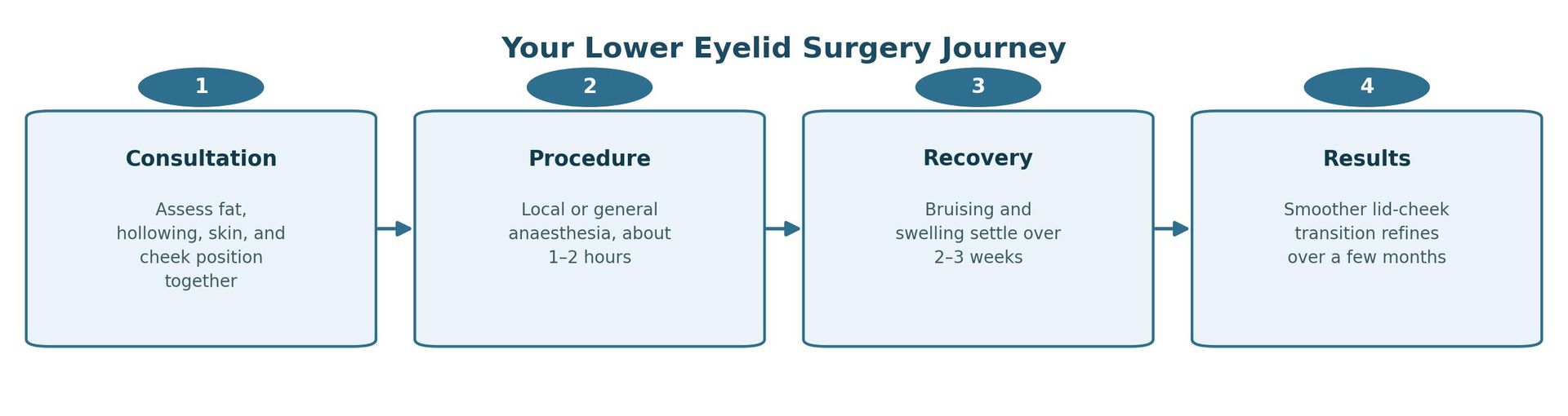
• Surgery is usually done under local anaesthesia with sedation, or general anaesthesia, and takes around 1 to 2 hours
• Bruising and swelling are often more pronounced here than with upper eyelid surgery, settling over 2 to 3 weeks
• Cold compresses and keeping the head elevated help in the first few days
• Most people return to non-strenuous activities within a week to 10 days
• Final results, especially with fat grafting or a cheek lift, take a few months to settle as swelling resolves
FAQS
Which approach is right for me — transconjunctival or open?
If you mainly have puffiness from fat with good skin tone, the transconjunctival approach avoids any external scar. If you also have looser skin that needs trimming, the open approach allows both to be addressed at once. Your surgeon will assess your skin and fat separately before recommending one.
Why would a surgeon add fat instead of just removing it?
Older approaches to lower eyelid surgery focused on removing fat, which sometimes left the area looking hollow or over-corrected years later. Adding a small amount of your own fat to hollow areas like the tear trough tends to produce a softer, more natural result, and is now often favoured alongside or instead of pure fat removal.
What does a mid-cheek lift have to do with my eyelids?
The lower lid and upper cheek share a visual border. If the cheek has started to descend with age, that alone can create a hollow or tired look under the eyes, no matter what is done to the eyelid itself. Lifting the cheek can smooth that transition and is sometimes a more effective, longer-lasting solution than eyelid surgery alone.
Is lower eyelid surgery riskier than upper eyelid surgery?
It carries a somewhat higher risk of complications like lid malposition, because the lower lid has less structural support and plays a role in keeping the eye protected. This isn't a reason to avoid it, but it is worth choosing a surgeon experienced specifically in lower lid techniques.
How long does swelling take to settle after fat grafting?
Grafted fat can look fuller than the final result for several weeks as swelling resolves, and it takes a few months to see how much of the graft has taken. Patience in this period is genuinely part of the process.
Can this be done together with upper eyelid surgery or a cheek lift?
Yes, combining procedures is common and can mean a single recovery period instead of several. Whether it's advisable in your case depends on your overall anatomy and health, which your surgeon will assess.
COMPLICATIONS AND MANAGEMENT
The lower lid is less forgiving than the upper lid because it plays an active role in supporting and protecting the eye, so this list is worth reading carefully alongside your surgeon's advice.
• Temporary bruising, swelling, and dry or watery eyes
• Under- or over-correction of fat, or asymmetry between sides
• Ectropion or lid retraction — the lower lid pulled down or outward, which can occasionally need corrective surgery
• Visible scleral show (white of the eye visible below the iris)
• Contour irregularities after fat grafting, such as lumps or uneven take
• Rarely, bleeding behind the eye is a medical emergency requiring urgent attention