
GYNAECOMASTIA
Dr Chia Hui Ling
Gynecomastia is the benign enlargement of glandular breast tissue in males, common at points of hormonal change such as puberty and older adulthood. In many adolescents it settles on its own within one to two years, but it can persist into adulthood or appear later in life, and beyond the physical appearance, it often brings real self-consciousness about being shirtless in public.
• Can flatten and reshape the chest contour for a more typical male chest profile
• Often improves confidence and comfort in situations such as swimming or exercising without a shirt
• Addresses both the glandular and fatty components when both are present
• Long-lasting result once any underlying contributing factor is identified and addressed
• Men with persistent glandular enlargement that has not resolved with time
• Those in good general health without an untreated underlying hormonal cause
• People who have completed growth, or in adolescents, once puberty-related change has plateaued
• Anyone who understands the difference between true glandular gynecomastia and fat-only enlargement (pseudogynecomastia), which is clarified during assessment
Gynecomastia is not usually a sign of a serious health problem, but because it can occasionally be linked to an underlying medical condition or medication, a thorough evaluation before considering surgery is a sensible first step, not just a formality.
TREATMENT
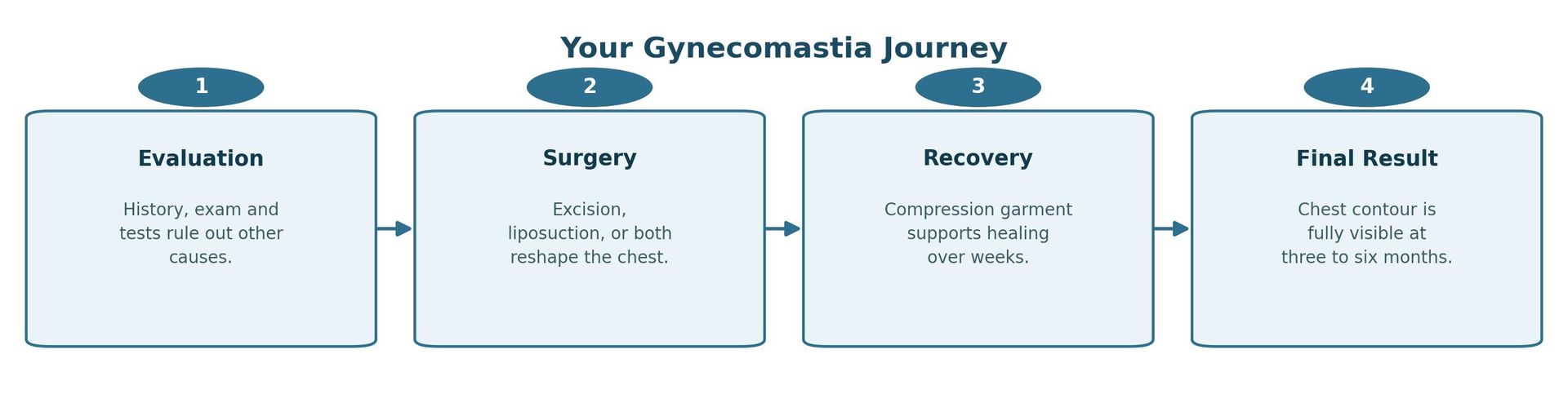
A doctor will typically take a history, examine the chest, and may order blood tests or imaging to look for an underlying or reversible cause, particularly if the enlargement is recent, one-sided, or associated with other symptoms. If a reversible cause such as a medication is found, addressing that may be tried first.
• Liposuction alone: suitable when the enlargement is mostly fatty tissue
• Surgical excision: removes firm, disc-like glandular tissue through a small incision, often at the edge of the areola
• Combined liposuction and excision: the most common approach, since most cases involve both fat and gland
Surgery is usually day surgery under general anaesthesia or local anaesthesia with sedation. A compression garment is typically worn for several weeks afterward to reduce swelling and support the chest. Most people return to desk-based work within a few days to a week, while strenuous exercise and heavy lifting are generally avoided for four to six weeks. Swelling settles gradually, and the final chest contour is best judged at three to six months.
FAQs
Is gynecomastia common?
Yes, it is common, particularly during puberty and in older age, and a noticeable degree of chest enlargement affects a substantial proportion of men at some point.
Will gynecomastia go away on its own?
In adolescents, it often resolves within one to two years as hormone levels stabilise. In adults, gynecomastia that has been present for a long time, especially once the tissue has become firm and fibrous, is less likely to resolve without treatment.
Can diet and exercise alone get rid of it?
Exercise and weight loss can reduce the fatty component of chest enlargement, but they cannot remove true glandular breast tissue, which typically needs surgical excision if treatment is wanted.
Will there be visible scarring?
Incisions are usually placed at the edge of the areola or through small liposuction access points, and scars are generally designed to be as inconspicuous as possible, though individual healing varies.
Can gynecomastia come back after surgery?
Recurrence is uncommon once glandular tissue has been removed, but it can happen if an underlying cause, such as certain medications, hormonal imbalance, or significant weight gain, is not addressed.
Do I need tests before surgery?
Many surgeons take a history, examine the chest, and may recommend blood tests or imaging, especially if the enlargement is new, one-sided, or associated with pain or nipple discharge, to rule out other causes first.
COMPLICATIONS AND MANAGEMENT
Bruising and swelling are expected in the first few weeks and settle on their own.
• Temporary numbness or altered sensation around the nipple or chest
• Mild asymmetry between the two sides, which occurs to some degree even in unaffected chests
• Fluid or blood collection beneath the skin (seroma or haematoma), occasionally needing drainage
• Infection, contour irregularities, or a dimpled appearance
• Under- or over-correction of tissue, sometimes needing a revision procedure
• Scarring around the areola that is usually inconspicuous but can occasionally thicken or become more visible
Recurrence after surgery is uncommon but can happen, particularly if an underlying hormonal cause, medication, or significant weight gain persists, which is why identifying and addressing any contributing factor matters for a lasting result.