LIP SURGERY
Dr Chia Hui Ling
Lip surgery covers a group of procedures that change the size, shape, or position of the lips through a lasting structural change, distinct from non-surgical filler injections. It can address lips that appear thin, a long distance between the nose and upper lip, disproportionately full lips, or asymmetry.
• Longer-lasting or permanent change to lip shape and proportion, without repeated filler appointments
• Can reveal more of the pink lip border (vermilion) and shorten an elongated upper lip
• Can reduce lips considered disproportionately full
• Can correct asymmetry from anatomy, trauma, or previous procedures
• People bothered by lip proportions who want a permanent alternative to repeated filler
• Those with a long upper lip or reduced vermilion show related to ageing
• People with lip asymmetry or after-effects of trauma or prior procedures
• Anyone with realistic expectations about the degree of change achievable for their anatomy
As with most facial surgery, the right procedure depends heavily on individual anatomy and goals, and swelling in the early weeks can temporarily distort the result, so patience is needed before judging the final outcome.
TREATMENT
The procedure is usually done under local anaesthesia with sedation, or general anaesthesia if larger areas are involved. Fat is harvested through gentle liposuction, most commonly from the abdomen, thighs, or flanks, then processed to isolate the healthiest fat cells before being carefully injected in very small amounts through a fine cannula, layer by layer, for an even and natural-looking result.
• Procedure typically takes 1 to 2 hours depending on the areas treated
• Swelling and bruising occur at both the donor site and the injected areas, usually for 1 to 2 weeks
• Treated areas often look fuller than intended at first, due to swelling and planned overcorrection
• A portion of the fat is reabsorbed over 3 to 6 months, afteMost procedures are done under local anaesthesia, sometimes with light sedation, on a day-surgery basis.
• Lip lift: removes a small strip of skin beneath the base of the nose and repositions the upper lip upward; the incision is hidden within the natural crease under the nose
• Lip reduction: removes a controlled amount of tissue from the inner surface of the lip, keeping scarring hidden inside the mouth
• Fat grafting: fat is harvested from another part of the body, processed, and injected into the lip for natural augmentation
• Lip implants: a soft surgical-grade material is placed through a small incision at the corners of the mouth, as an alternative to repeated filler
• Corrective surgery: addresses asymmetry, scarring, or after-effects of trauma or previous procedures
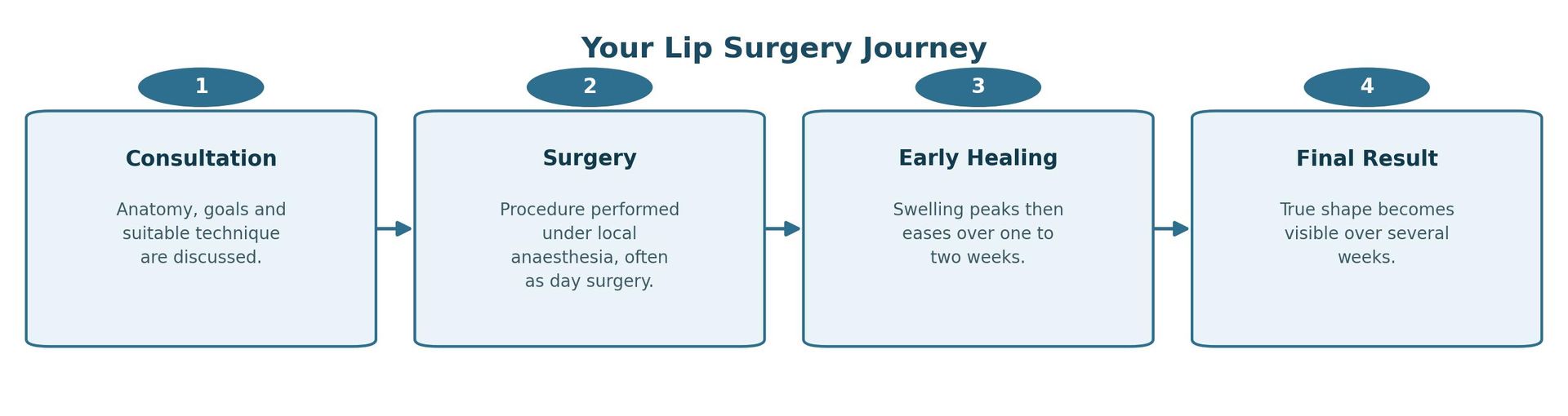
Surgery commonly takes one to two hours, and swelling is often most pronounced in the first two to three days, temporarily distorting the result. Most people return to non-strenuous activity within a few days to a week, though tightness or firmness can persist for several weeks as tissues settle. Non-dissolvable sutures are typically removed within one to two weeks.
r which the true final volume is assessed
• One or two top-up sessions are sometimes needed to reach the desired lasting result
• Strenuous exercise and direct sun on treated areas should be avoided in the initial weeks
FAQs
How is lip surgery different from lip fillers?
Fillers use an injectable gel that gradually breaks down over months, needing repeat treatments to maintain. Lip surgery changes the tissue structurally, generally giving a longer-lasting result without ongoing maintenance injections.
Is lip surgery painful?
Most procedures are done under local anaesthesia with or without sedation, and afterward discomfort is usually mild to moderate swelling and tightness rather than significant pain, manageable with simple pain relief.
How long does recovery take?
Initial swelling and bruising typically improve substantially within one to two weeks, allowing a return to most activities, though subtle swelling can take several weeks to fully settle before the final result is apparent.
Are the results permanent?
A lip lift and lip reduction produce generally permanent structural changes, though lips continue to age naturally. Fat grafting results can be long-lasting, but some transferred fat may be gradually reabsorbed.
Who is a good candidate?
Good candidates are generally in good health, have a specific concern such as a long upper lip or asymmetry, and have realistic expectations about the degree of change achievable. A consultation helps determine which procedure, if any, suits your anatomy.
Will my lips look overdone or unnatural?
With attention to facial proportion and conservative tissue changes, lip surgery aims for a natural-looking improvement rather than a dramatic alteration. Discussing your goals clearly beforehand helps achieve a result suited to your face.
COMPLICATIONS AND MANAGEMENT
Swelling, bruising, and temporary firmness are expected in the first one to two weeks and gradually resolve.
• Asymmetry between the two sides of the lip, which may settle with healing or occasionally need revision
• Scarring, usually well concealed but occasionally more visible than expected
• Altered sensation, including temporary or, rarely, prolonged numbness
• Infection or delayed wound healing
• Uneven survival of transferred fat after fat grafting, sometimes needing a touch-up
• For implants, the risk of it becoming palpable, shifting, or rarely needing removal due to infection or extrusion
• Overcorrection or undercorrection relative to expectations
Active cold sores, certain bleeding disorders, and unrealistic expectations about achievable change are important points covered during assessment, and a detailed consultation on anatomy and goals helps reduce the risk of an unsatisfactory outcome.